Slots are not software delivery vehicles. They are capital assets.
Drew Pawlak wrote something last week that sparked a conversation worth having. He’s right that the secondary market has real problems — software leakage, weak chain of custody, participants who operate with far less accountability than operators, OEMs, and regulators would prefer. Those aren’t fringe concerns. They’re legitimate, and in many ways they’re exactly why we founded SlotCycle.
But I think the discussion misses something important if it stops there, and I want to offer a different frame.
When an operator buys a slot machine, they’re not licensing software. They’re acquiring a capital asset. They take on the financing risk, the floor risk, the maintenance cost, the liability, and the regulatory responsibility for safely disposing of that equipment when it’s no longer earning on their floor. They own it. And like any capital asset — a truck, a building, a piece of manufacturing equipment — they have a legitimate right to recover full value from it when the time comes.
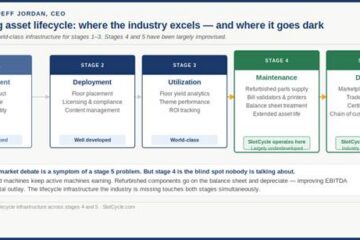
For most of the industry’s history, that recovery has been an afterthought. OEMs are exceptional at what they do — designing, building, and selling innovative gaming products. But the back end of the asset lifecycle — disposition, refurbishment, secondary distribution, recycling, end-of-life management — requires a completely different set of capabilities. Most OEMs were never built for that. It’s not a criticism. It’s just a different business. And it left a gap that the secondary market grew up to fill.
The dollars operators recover from retired assets don’t disappear from the industry. They get reinvested — into new machines, new content, new technology, new OEM products. A well-functioning secondary market doesn’t compete with OEM innovation. It helps fund it.
The secondary market also serves operators the rest of the industry rarely talks about.
Not every casino in the world can underwrite new-machine economics — slot yields are often thin, and in many markets purchasing power is simply too weak to justify the price of new iron. Smaller operators, some tribal gaming markets, Latin America, the Caribbean, emerging jurisdictions — these are real regulated markets with real customers. The secondary market has historically been how they accessed gaming technology, built their floors, and grew their businesses. Eliminating it doesn’t make those markets disappear. It just makes them harder to serve and easier to ignore.
Here’s where I think the conversation needs more precision.
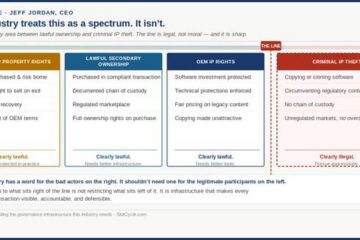
We tend to conflate three things that are actually quite different from each other:
- Lawful secondary ownership — an operator selling an asset they legally own
- Operator property rights — the right to recover value from capital they purchased
- Criminal IP theft — copying software, cloning content, circumventing regulatory controls
The industry should pursue IP theft aggressively. Full stop. But the solution to criminal behavior isn’t to eliminate or restrict the legitimate property rights of operators who did nothing wrong. OEMs should make their software harder to copy and use commercial terms to make unauthorized resale less commercially attractive to secondary market participants. Those are solvable problems. They don’t require dismantling a market that serves legitimate purposes.
An operator selling a lawfully owned machine through a transparent, documented, regulated transaction is not the same as a bad actor copying software. Treating them as equivalent doesn’t protect IP. It just punishes operators and concentrates market power.
So what does a better market actually look like?
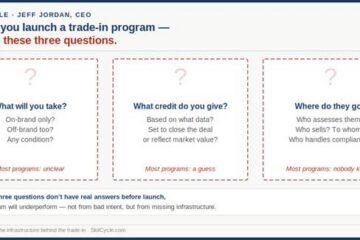
A better market has verified ownership and documented chain of custody at every transaction. It has real IP enforcement — not just contractual language that sits in a drawer. It has regulatory visibility, asset tracking, and lifecycle reporting so everyone knows where equipment has been and where it’s going. Trade-in programs price assets at actual market value, not at a discount engineered to make new inventory more attractive. Secondary market participants have a credible path to source secondhand machines through certified OEM resellers, which keeps product in compliant channels and gives OEMs meaningful control over where their equipment ends up. And retired equipment gets responsibly recycled, not abandoned in unregulated markets.
That’s not a defense of the secondary market as it exists today. It’s a description of what it should become — and what the industry has the tools to build if it chooses to.
That vision is what led us to build SlotCycle. We operate SlotCycle.com — connecting buyers and sellers of gaming equipment with services built around the full asset lifecycle: marketplace, consignment, liquidation, refurbishment, logistics, trade-in programs, and recycling. We didn’t build it to preserve the status quo. We built it because operators, OEMs, and regulators all deserve a better version of this market — one that’s transparent, auditable, and accountable at every step. We’ve proven that model works, having partnered with some of the largest operators and OEMs in the industry.
The industry doesn’t have to choose between protecting OEM intellectual property and protecting operator capital rights. It doesn’t have to choose between compliance and liquidity, or between innovation and a functioning secondary market. What it needs is the infrastructure to do all of it at once.
That’s the conversation I’d like to keep having. Perspectives from operators, OEMs, regulators, and anyone else with skin in how this gets resolved are welcome.
— Jeff Jordan
Founder & CEO, SlotCycle
#gaming #slotcycle #secondarymarket #gamingassets #casinoindustry #assetlifecycle #slotmachines

0 Comments