
Figure 1: The difference between a warehouse full of scrap and a $1.4M recovery is one decision made on day one.
The million-dollar warehouse
I want to tell you about a warehouse I walked when we were starting SlotCycle.
Three hundred and fifty retired slot machines. Rows of them, stacked and shoved into corners, some tilted against each other, some missing doors. One had a door that looked like someone had taken a hammer to it in frustration. On paper, the inventory still looked like it might be worth something — the cabinets were recognizable, the brands familiar. You could tell they had been real machines on a real casino floor not that long ago.
The further we walked, the worse the picture got. Machines had been cannibalized for parts — someone needed a bill validator or a display and just pulled it, leaving the unit incomplete. One had the bill validator door bent at such an angle it raised the question of how that even happened. Others had been moved without proper care, taking damage in transit. Some had sat long enough for moisture to work its way in. The paper inventory list inadequately described the condition of the slots we observed. Managers and staff had treated these machines as disposable assets, not as ones that once had value. They had been ignored until they became someone else’s problem.
We did the math. Properly assessed, documented, and moved to market within a reasonable window after coming off the floor, that inventory could have sold for approximately $1.4 million. By the time we walked in, that value was gone. We passed on the inventory. Later, we were told that another buyer took it without fully understanding the condition and ran into serious problems. The operator was left frustrated with the whole experience. That operator later became one of SlotCycle’s original customers — and we’ve had a long, successful relationship with them ever since.
The machines weren’t worthless because they were old. They were worthless because of what happened to them after they left the floor.
How much value is sitting in warehouses across our industry right now?
That’s not a rhetorical question. Based on everything we’ve seen, the number is significant. Every year, decisions that aren’t made become value that is not recovered. The machines in that first warehouse didn’t have to become scrap. Someone just needed to decide — early enough for it to matter. Many casinos liquidate their used slot machines as soon as they come off the floor.
This story is not unusual. That’s the problem.
I’ve walked enough warehouses to know that what happened in that room plays out across this industry every year — in properties large and small, with inventories of every size. Machines come off the floor and go into a holding pattern not because anyone decided that was the right move, but because nobody decided anything at all. And while the decision gets deferred, the value decays. Parts walk. Conditions deteriorate. The market window closes. Many casinos I work with liquidate their used slot machines as soon as they come off the floor, which I would consider a best practice.
Most operators know exactly what a slot machine earns on the floor. Most know exactly what a new one costs. Very few have a clear picture of what a retired machine is worth — and even fewer have a process for acting on that answer quickly enough to matter. The industry has invested enormously in the front end of the asset lifecycle. The back end has been an afterthought for too long. Many casinos I work with liquidate their used slot machines as soon as they come off the floor, which I would consider a best practice.
There are options for recovering value.
Recently, we ran a structured liquidation of approximately 600 machines for an operator. Within sixty days, our realized proceeds had exceeded the next best alternative by more than $50,000 — with substantial inventory still available for sale. The difference wasn’t just process discipline. It was treating each machine as an individual asset with its own highest and best use — some sold as-is, some tested and verified before sale, some refurbished to command a better price, some harvested for parts — rather than running the whole pool through a single channel at a single price. The operator was so pleased that they gave us another 100 slots to liquidate.
That approach — five distinct paths, one deliberate decision per machine — is the foundation of how SlotCycle manages every disposition project. And it’s the answer to a question the industry rarely stops to ask: what is this specific machine actually worth, and what’s the best way to realize that value?
Every retired machine has a highest and best use.
Some machines are better off sold for parts. Some sell well in one of three conditions, depending on the needs of the buyer: as-is, tested and working, or fully refurbished. Others need to be recycled because there is no longer a market for them. The right path isn’t the same for every asset in a pool, and it isn’t static. It depends on the condition of the machine, the depth of the market at that moment, the types of buyers actively purchasing, and the operator’s timeline. Getting that call right — machine by machine, not just pool by pool — is the difference between a warehouse story and a recovery story. The framework below is how we make that call systematically, at scale, across every project we run.
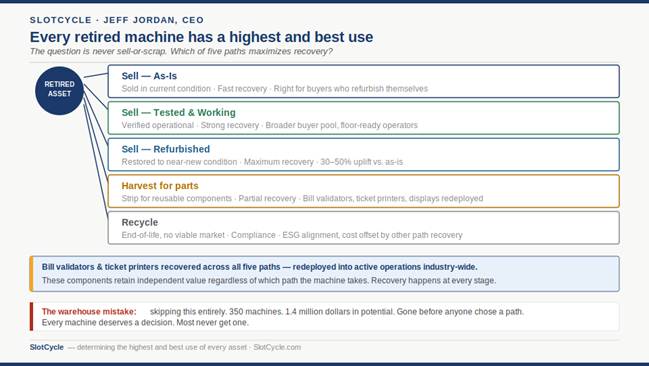
Figure 2: The five disposition paths — each machine routed to its highest and best use.
SlotCycle was built to make that decision easier. We provide the assessment, the market valuation, the logistics, the refurbishment capabilities, the recycling partnerships, and through Slot Registry on SlotCycle.com, the real-time visibility that operators and OEMs need to manage gaming assets the way they manage every other financial asset in the business. We’ve processed over 30,000 machines, working with large and small operators and OEMs across the industry. We know what’s possible when the decision gets made early.
If you’ve got machines sitting in storage right now, I’d be glad to have that conversation.
— Jeff Jordan
Founder & CEO, SlotCycle
#gaming #slotcycle #assetmanagement #casinoindustry #gamingassets #lifecyclemanagement #slotmachines

0 Comments