
The three questions most trade-in programs never answer before launch.
Why OEM trade-in programs are hard
Most OEM trade-in programs are designed to close deals. That’s the problem.
A sales rep is working an account. The operator wants to move aging inventory before committing to new equipment. The rep offers a trade-in credit to get the deal across the line. It works — the deal closes, the new machines ship, and everyone moves on. What nobody has fully answered is what happens next. Do you take on-brand machines only, or off-brand too? What’s the right credit to give, and how do you know? Where do the machines actually go? Who assesses them? Who sells them, and to whom, and at what price? Who handles logistics, refurbishment, recycling? Who is responsible for compliance on the downstream transaction?
Those questions don’t get answered because the program was never designed to answer them. It was designed to close the deal. The back end was an afterthought — or no thought at all.
This is how trade-in inventory ends up in warehouses.
Machines come in faster than the organization can process them. Nobody has the valuation capability, the buyer relationships, the refurbishment capacity, or the recycling infrastructure to move them efficiently. So they sit. Storage costs accumulate. Eventually someone decides to liquidate the lot to a broker at a low price just to clear the space — and the OEM captures a fraction of what the inventory was worth. The program gets a reputation for delivering poor trade-in values, operators push back, and the whole thing quietly scales back.
It’s not a motivation problem. It’s not a pricing problem. It’s an infrastructure problem. And you can’t solve an infrastructure problem by asking a sales team to run a liquidation operation on the side.
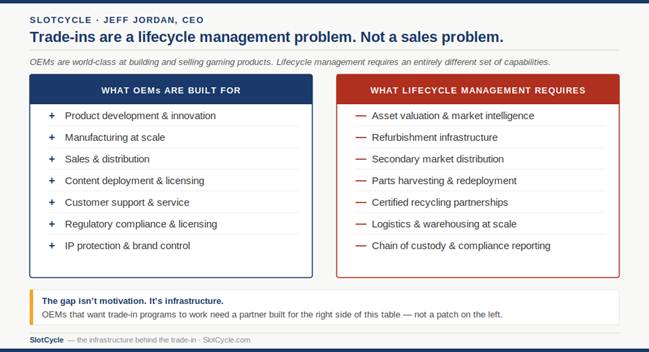
Figure 1: The capability gap that explains why most trade-in programs underperform.
Building with the end in mind looks different — and the economics are compelling.
Start with the original sale. When the rep is quoting a deal, the choice isn’t between a trade-in and full price — it’s between a trade-in and a cash discount. If the operator wants $2,000 off a $10,000 machine, the OEM can either cut the invoice to $8,000 or offer a $2,000 trade-in credit. Under ASC 606, both book the same net revenue on the original sale. But the trade-in structure converts what would have been a pure margin concession into a recoverable asset. The OEM books no inventory, no liability — just a clean $8,000 sale — and the machine moves to a partner who can actually do something with it.
Then the downstream economics kick in. When SlotCycle sells that machine — assessed, routed to its highest and best use, sold through our marketplace — we return a revenue share to the OEM. That payment books as other income or a contra expense, entirely separate from the original transaction. The margin on the sale is protected. The OEM then receives additional income on top. What started as a discount becomes a revenue stream. The deck we share with OEM partners puts it plainly: SlotCycle turns a cost center into a profit center.
It’s also a sales tool.
Trade-in programs done well don’t just help OEMs manage inventory — they help operators afford new equipment. For many mid-size operators, the value locked in aging machines on the floor is real capital that could fund the next purchase cycle. A well-structured trade-in program gives them a direct path to mobilize that capital — retire old inventory, apply the recovered value toward new equipment, and upgrade their floor without the full cash outlay. That makes the OEM’s sales conversation materially easier. The rep isn’t asking the operator to find budget from somewhere. They’re showing them how to fund the purchase with assets they already own. The trade-in becomes a financing mechanism, and the OEM becomes a partner in solving the operator’s capital problem rather than just another vendor asking for a purchase order.
There’s also a compliance dimension most OEMs haven’t fully considered.
In a properly structured program, the partner — not the OEM — takes title to the machines at the point of transfer. The partner becomes the seller of record. All downstream compliance responsibility sits with the partner, not the OEM. The trade-in is clean on day one, and it stays clean regardless of where those machines end up. For OEMs that have historically worried about where their product lands in secondary markets, this is the structural answer — not a policy, not a contract clause, but a transaction design that removes the exposure entirely.

Figure 2: Five steps that turn a deal discount into a downstream revenue stream.
We’ve seen this model work in practice.
We recently launched a structured trade-in program with an up-and-coming OEM that takes in slot machines that their casino customers want to replace as part of a new equipment purchase. Those machines ship directly to SlotCycle’s facility. We assess, route to the highest and best use, sell through our marketplace, and return a share of proceeds to the OEM. The OEM captures value from machines they never manufactured, their customers get a cleaner trade-in experience, and the sales team has a tool that makes deals easier to close. Because SlotCycle is the seller of record on every downstream transaction, the OEM carries no compliance exposure on any of it.
In under nine months that program has generated meaningful revenue on machines acquired at minimal cost basis. The demand is there. The market is real. The only thing that was missing was the infrastructure to capture it.
If you want more trade-ins, build the back end first.
The three questions every OEM needs to answer before launching a program: What machines will you take — on-brand only, or off-brand too? What credit will you give, and how will you know if it’s right? And where do they go the day they arrive? If those questions don’t have real answers, the program will underperform — not because of bad intent, but because the infrastructure wasn’t there.
SlotCycle was built to be that infrastructure. We provide the valuation intelligence, the physical processing capability, the buyer network, the compliance structure, and through Slot Registry on SlotCycle.com, the real-time visibility that lets OEMs see exactly what’s happening to their trade-in inventory at every stage. We’ve worked with OEMs and built programs that run. We know what it takes.
If you’re an OEM thinking about how to build a trade-in program that actually performs, I’d be glad to have that conversation.
— Jeff Jordan
Founder & CEO, SlotCycle
#gaming #slotcycle #OEM #tradein #casinoindustry #gamingassets #lifecyclemanagement #slotmachines

0 Comments