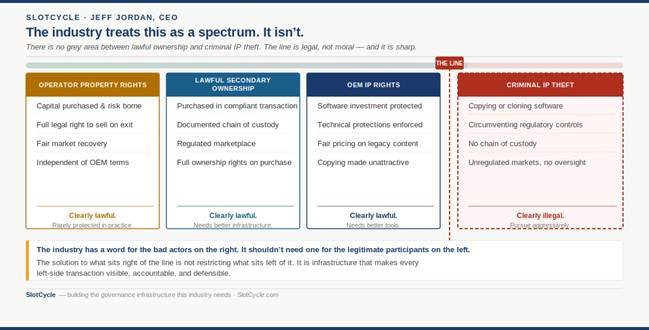
Four distinct categories the industry treats as one problem, with one blunt solution that consistently hits the wrong target.
Ownership rights vs. IP protection: the industry is having the wrong argument
Drew Pawlak raised something important in a recent post about the secondary market. His core point — that the market has real accountability problems, that IP leakage is genuine, that the industry needs better controls — is correct. I’ve said so publicly and I’ll say it again here.
But the conversation keeps arriving at the wrong solution, and I think it’s worth being specific about why.
The industry is conflating four things that require four different responses.
The first is operator property rights. When an operator invests capital in gaming equipment, they don’t just acquire a software license. They acquire a physical asset. They bear the full economic risk — financing, floor performance, maintenance, regulatory compliance, and legal liability for the eventual responsible disposal of that equipment. That last point matters more than the industry acknowledges: operators are legally responsible for what happens to their machines at the end of life, which means they need real options, not just whatever an OEM trade-in program offers on any given day. They have the right to choose when, how, and under what economic circumstances they liquidate their assets — and the right to recover fair market value when they do. That right exists independent of their relationship with the OEM, and it exists because they bore all the risk.
None of that diminishes what OEMs bring to this industry. The software, content, and technology they invest in developing are genuinely valuable and deserve real protection, which brings us to the second category.
OEM IP rights need better tools, both technical and commercial. On the technical side, software that is genuinely difficult to copy is the first line of defense. On the commercial side, the music industry figured this out twenty years ago: when Apple made legitimate access convenient and fairly priced at 99 cents a song, the economics of piracy collapsed. The incentive to copy gaming software drops significantly when OEMs price legacy content at levels that reflect its age and actual market value rather than original list price. Accessible pricing is IP protection. Restriction alone is not.
The third is lawful secondary ownership. Not every buyer of a used slot machine is a bad actor. An operator in a commercial, tribal market, a smaller casino in Latin America, an emerging jurisdiction building its floor — these are real regulated operators purchasing equipment through documented, compliant transactions. They take legal title. Chain of custody is maintained. The IP stays with the original OEM. That is a capital market functioning exactly as it should. It is not a grey area. It is not a problem to be solved — it is a market that needs better infrastructure: cleaner documentation, stronger compliance visibility, and a verified chain of custody at every step.
The fourth is criminal IP theft. Copying software. Cloning game content. Circumventing regulatory controls to move an unlicensed product into regulated markets. Operating without a chain of custody, without compliance documentation, without accountability to anyone. This is genuinely harmful; it should be prosecuted aggressively, and the industry should build the infrastructure that makes it structurally harder to execute.
These four things are related. They are not the same thing.
The mistake the industry keeps making is treating them as a single problem with a single solution. When IP protection conversations bleed into restrictions on secondary ownership, legitimate operators get penalized for the behavior of bad actors they have nothing to do with, and for vulnerabilities that arise because software protection was never designed with secondary-market realities in mind. When trade-in programs are designed to capture operator assets at below-market prices, it gets dressed up as IP protection, but it’s actually market consolidation. When the secondary market gets characterized as inherently problematic, the operators in lower-yield markets who depend on it for access to gaming technology get written out of the conversation entirely.
The industry has a word for the bad actors on the right side of the line. It shouldn’t need one for the legitimate participants on the left.
The answer to IP theft is pursuing IP theft — directly, aggressively, with the right tools. What it is not is restricting the three categories on the left side of the line, all of which are lawful, all of which serve legitimate purposes, and all of which the industry needs to function.
Here’s the question the industry should actually be asking.
Not “Should we protect IP?” — of course we should. The question is: how do we build an infrastructure that makes lawful secondary ownership fully accountable and transparent, while making IP theft structurally harder to execute? Those two objectives point toward the same infrastructure. Verified ownership and documented chain of custody at every transaction makes lawful ownership more defensible and IP theft more visible. Trade-in programs priced at fair market value give operators a real alternative to secondary markets for asset recovery. Certified recycling that ensures retired equipment can never be reconstituted closes the back door that bad actors currently exploit.
This is a governance problem. It requires a governance solution. And governance solutions require infrastructure — not just policy.
That infrastructure is what SlotCycle was built to provide.
We operate at the intersection of all four categories. We work with operators who have legitimate assets to sell and deserve fair recovery. We work with OEMs who want their product in the right channels with the right accountability. We work with regulators who need visibility into what’s happening to gaming equipment after it leaves the floor. We’ve built the marketplace, the logistics, the compliance infrastructure, and through Slot Registry on SlotCycle.com, the audit trail that lets every seller see exactly where an asset has been and the details of the sale.
The industry doesn’t have to choose between protecting OEM intellectual property and protecting operators’ capital rights. It doesn’t have to choose between compliance and liquidity. It doesn’t have to choose between IP protection and a functioning secondary market.
It needs the infrastructure to do all of it at once. That’s the conversation I’d like to keep having.
— Jeff Jordan
Founder & CEO, SlotCycle
#gaming #slotcycle #secondarymarket #IPprotection #gamingassets #casinoindustry #lifecyclemanagement

0 Comments